Blog
Last updated: May 1, 2026
Dog collars in multi-dog households: How to prevent them from biting and breaking each other's collars

Living in a household with multiple dogs is a wonderful experience, but it also brings unique logistical challenges, especially when play becomes intense. One of the most common and costly problems for owners is the habit of dogs biting and destroying their companion's collar during play sessions or out of simple boredom.
This behavior not only represents a constant expense on new accessories, but it can also pose a risk of choking or ingestion of dangerous materials. Choosing the right material and knowing certain management strategies is essential to maintain the safety of all members of the pack.
In this article, we will analyze which are the best materials for collars in multi-dog homes, how to identify the risks of rough play, and what measures you can take to protect the investment in your pets' gear without limiting their fun.
Coexistence and collars: the challenge of multi-dog households
Living with more than one dog is a wonderful experience, but it also brings unique logistical challenges. One of the most frustrating problems for owners is discovering that, after a play session, one of the dogs has bitten and destroyed their companion's collar. This behavior is very common, especially in puppies or young dogs with a lot of energy.
The 'wrestling' game usually includes grabbing in the neck area, which makes the collar the perfect target for teeth. In addition to the constant expense of replacements, a broken collar can pose a safety risk if it happens away from home or if the dog ingests pieces of plastic or metal material. Understanding why it happens and how to choose the right equipment is fundamental.
In this article, we will analyze the best strategies and materials to prevent collars from ending up as chew toys, ensuring the durability of the accessory and the safety of your pets.

Why dogs bite each other's collars
Play between dogs usually mimics hunting or ritualized fighting behaviors. During these interactions, the neck area is an instinctive target. When trying to hold the other, dogs end up biting the collar accidentally or deliberately, as it offers an interesting texture to chew.
In many cases, boredom or a lack of suitable toys can enhance this habit. If dogs do not have chew toys at their disposal, they will look for any object they have at hand, and the companion's collar is an accessory that is always 'available'.
Additionally, some materials like soft nylon or poorly treated leather release odors that can be attractive to the canine sense of smell, inciting them to lick or bite the area. Identifying whether it is rough play or destructive behavior is the first step to applying the correct solution.
Safety risks when breaking the collar
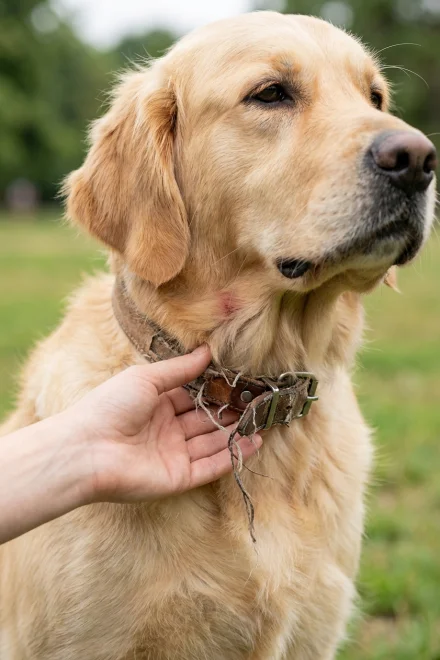
A chewed collar is not just an aesthetic problem; it represents a real danger to your dogs' health. The most immediate risk is the ingestion of small parts, such as plastic clasps, rings, or nylon fibers, which can cause serious intestinal obstructions.
Another critical danger is entrapment. If a dog gets its lower jaw under the other's collar while playing and it gets caught, both animals can panic. This can lead to choking or cervical injuries if there is no human nearby to intervene quickly.
Finally, a collar weakened by bites can break at the least opportune moment, such as during a walk through the city, leaving the dog loose and exposed to being hit by a car or running away. Checking the condition of the materials daily is a mandatory routine in multi-dog households.
Recommended materials to prevent breakage
Not all collars are manufactured to resist friction and another dog's teeth. If you have 'chewers' at home, you should prioritize materials that do not fray and are difficult to grab.
🛡️ Biothane (The king of resistance)
It is a synthetic material that mimics leather but is much more resistant. It does not fray, it is waterproof, and its smooth surface makes it difficult for the other dog to sink their teeth in easily.
⛓️ Chain collars (Stainless steel)
They are practically indestructible against bites. However, they should be used with caution and only under supervision, as they can damage the teeth of the dog that bites if they do so with force.
💪 High-density ballistic nylon
Unlike standard nylon, ballistic nylon has a much tighter weave that prevents threads from coming loose at the first contact with fangs, extending the life of the accessory.
🐄 Quality thick leather
A good double-layer leather collar is hard to pierce. It is important that the edges are well finished so that there are no starting points for tearing.
🚫 Avoid: Collars with decorations
Collars with decorative spikes, bows, or thin fabrics are an invitation to play. In multi-dog households, it is best to opt for minimalist and functional designs without hanging elements.
Investing in technical materials like Biothane is usually the most cost-effective solution in the long run, as they avoid the constant purchase of new collars and are extremely easy to disinfect.
Strategies to protect walking equipment
🧴
Apply a bitter-tasting repellent (special for pets) on the outside of the collar to discourage chewing.
🏠
At home, leave the dogs 'naked'. If they don't wear a collar, there's nothing to break and accidental snagging risks are avoided.
🎾
Encourage play with objects. If they have a ball or a chew toy in their mouth, they won't be able to bite their companion's collar.
🛠️
Choose collars with brass or steel hardware. Plastic breaks easily under the pressure of a strong jaw.
🧼
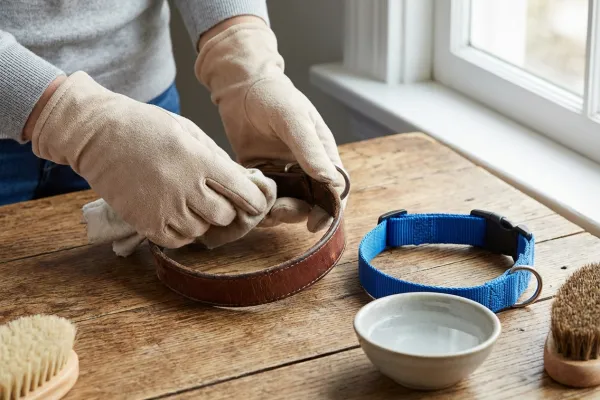
Keep collars free of organic residue. The smell of food or dirt attracts the attention of other dogs.
Technical comparison of anti-bite materials
For owners of multiple dogs, the choice of material is not an aesthetic issue, but one of technical resistance. Biothane has positioned itself as the preferred material for behavior experts and trainers. Its internal polyester structure coated with PVC makes it practically immune to the tears produced by a canine fang.
On the other hand, if the problem is that dogs 'chew' each other's collars while resting, metal collars (steel links) are the only impassable physical barrier. However, they are not recommended for dogs with sensitive gums or those who play very physically, as the impact of the metal can be painful.
Below, we present a comparative table to help you decide which material best suits the intensity of play in your home:
| Material | Bite resistance | Durability | Ease of cleaning | Safety in play | Price |
|---|---|---|---|---|---|
| Biothane | Very High | Excellent | Very easy | High | 25 € – 45 € |
| Reinforced Nylon | Medium | Medium | Difficult | High | 15 € – 30 € |
| Natural Leather | High | High | Medium | Medium | 30 € – 60 € |
| Steel Chain | Indestructible | Maximum | Easy | Low (Dental risk) | 20 € – 50 € |
In conclusion, the best strategy combines the choice of a technical material like Biothane with environment management, removing collars during hours of intense play at home.
Frequently asked questions about collars in multi-dog homes
Why do my dogs bite each other's collars?
It usually occurs during social play. Dogs use their mouths to interact, and the collar is an easy grip point. In other cases, it can be a sign of boredom or a learned behavior to get the other dog's attention.
What is the most bite-resistant material for other dogs?
High-resistance Biothane and ballistic nylon are excellent. However, for very persistent dogs, stainless steel link collars or materials with hardened coatings are usually the only ones that survive sharp teeth.
Is it dangerous for a dog to bite another's collar?
Yes, there is a risk that the biting dog's jaw could get caught in the other's collar, which can lead to panic, choking, or serious neck injuries for both. There should always be supervision during intense play.
Are there sprays to prevent them from biting the collar?
Yes, there are sprays with a bitter taste (such as bitter apple) designed for pets. Applying a little to the outside of the collar can deter the other dog from biting it, although its effectiveness varies by individual.
Should I take their collars off when they are inside the house?
In multi-dog households, it is a recommended safety practice to remove collars indoors if the dogs play unsupervised. This eliminates the risk of accidental snags and unnecessary wear from biting.
What type of buckle is best to prevent it from being taken off during play?
Traditional metal buckle closures are more secure than plastic quick-release buckles, as the latter can break or open easily if another dog exerts direct pressure with their teeth on the mechanism.
How can I clean the collar if it's always full of other dogs' saliva?
Ideally, use collars made of non-porous materials like Biothane, which are cleaned simply with a damp cloth and do not absorb odors or bacteria from saliva, unlike nylon or leather.
Do metal collars damage the biting dog's teeth?
If a dog bites a metal collar with great force and frequency, they could suffer dental wear or fractures. In these cases, it is better to work on behavior modification than simply changing the material.
What should I do if my dog swallows a piece of a collar?
You should go to the veterinarian immediately. Pieces of plastic, metal, or heavy-duty fabric can cause serious intestinal obstructions that often require surgery.
Is there a collar design that is less 'attractive' to bite?
Low-profile and snug-fitting collars (without dangling parts or excessively large rings) offer fewer grip points, reducing the temptation and ease for the other dog to catch it with their mouth.